The Artistry of Luxury
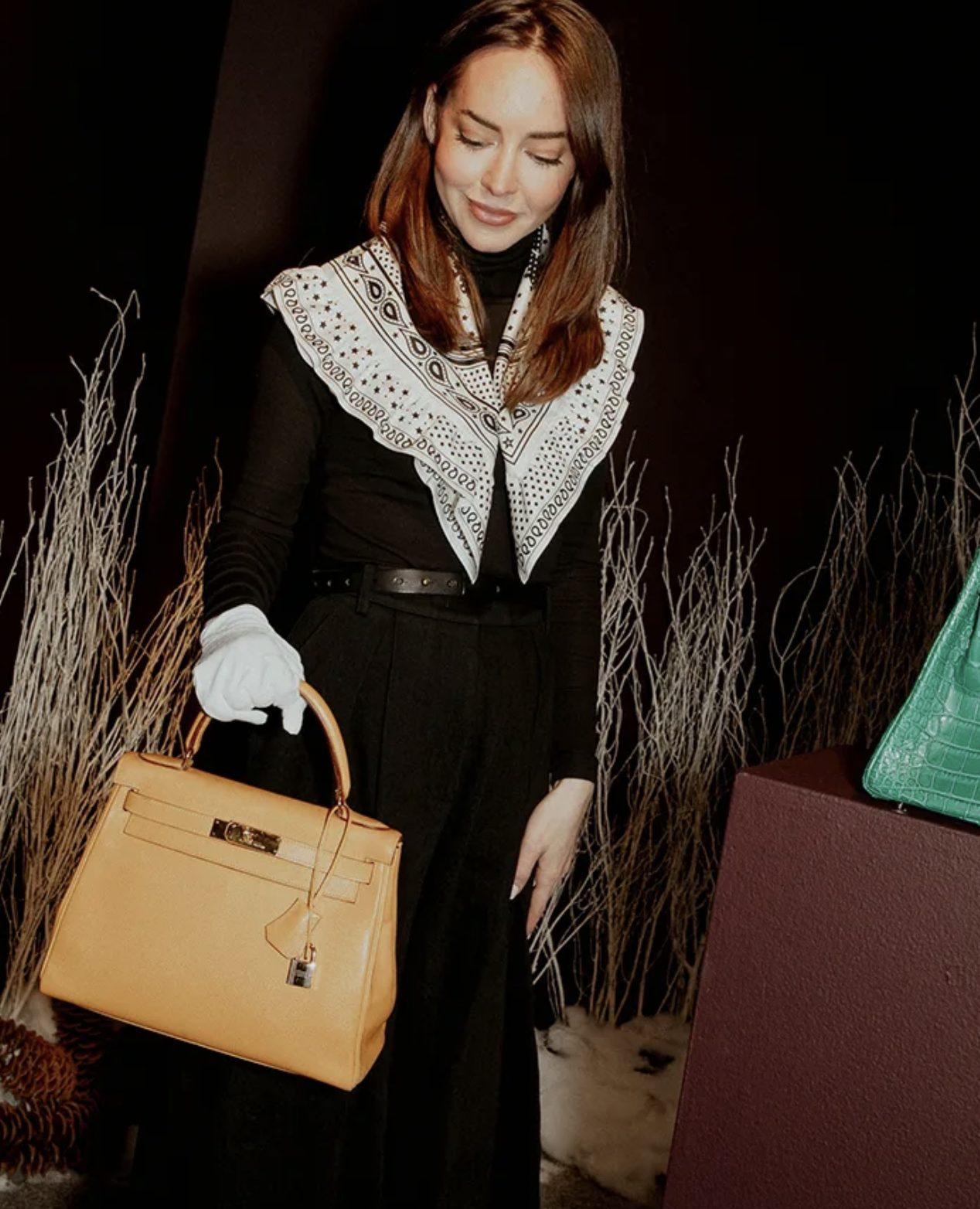
Abigial Goodman. HERMÈS: JAUNE D'OR COURCHEVEL KELLY I RETOURNÉ 28, 1993
Abigail Goodman's Guide
to Hermès Heritage, Made Modern
Bonham’s upcoming Hermès: From the Vault auction celebrates the Maison's timeless heritage and unwavering commitment to quality and artisanal skill.
To mark the occasion, they invited Hermès historian and scarf collector, Abigail Goodman, to share her start in the luxury auction market, perspective on the storied craftsmanship of Hermès, and her personal collecting journey. We share the interview here.
There are many different buying avenues within the secondary luxury market. What led you to the auction business?
For me this is really a two-part answer because the love of Hermès scarves came first. I’ve always loved art and fashion, and Hermès scarves sit exactly at that intersection. Each design is created by a different artist with a body of work outside the brand, and every motif has its own story. Some stories are about what the design represents, some commemorate a moment, and technically every scarf is a limited edition since it’s only produced for a season before disappearing or reappearing in a new format. They’re beautiful, yes, but there’s so much more to say.
My business began by posting stories and tutorials on social media, and when people started asking, “Can you help me sell my scarf?” I said yes. That then led to my online Hermès scarf consignment boutique. I offer certain motifs for immediate purchase in my biweekly restocks, and others I hand-select for auction. I love the auction format because it shows the true fair market value, which gets especially exciting with rare and collectible motifs.
I recently put together a first of its kind Hermès Kermit Oliver auction featuring nearly every motif he ever created. Kermit Oliver is known for his Texan roots and southwestern themes, and his designs are some of the most sought after in the Hermès scarf world. It was incredibly exciting to see how the full collection performed at auction, and to watch the growing demand for specific artists and motifs in real time.
What are the benefits of buying at auction versus buying new from an Hermès store or a major reseller?
While it’s always fun to have the Hermès store experience, you’re really only seeing a tiny slice of what’s available; typically only motifs from the current and past season. With auction, you never know which vintage motif or limited edition you'll find, and the range is so much wider.
At my Abigail Goodman Scarf Boutique Pop-Up during the Bonhams New York Finer Things preview event, so many visitors, even those familiar with Hermès scarves, discovered motifs they had never seen before, and loved them. The prices vary too, which is great for different levels of accessibility.
Winning a vintage style is its own little (or big) victory. It feels personal, almost like a trophy, and you know you’ll be the only one wearing it.
Bidding and purchasing at auction can be a little daunting for first-time buyers.
What advice would you give to someone new to the process, and how can they feel confident about the authenticity and condition of the items?
At this point I’m living and breathing Hermès scarves, and I love it. When you reach out to my business as a consignor or a buyer, or even just message me, you’re talking directly to me. I handle all authentication myself, and I’ve even made videos debunking authentic reports from major authentication companies that rely on AI software.
I always recommend buying from sources you trust, with a solid track record and real reviews. And when you’re purchasing through an auction house, make sure you know whether it’s a live auction or a timed auction, because your bidding strategy should change completely. A live auction gives you a final call after you bid, so everyone gets a fair shot. A timed auction has a countdown that encourages last-minute bidding. The format matters, and understanding the difference will absolutely affect how you bid.
What first sparked your passion for Hermès?
The crossover between art and fashion is what pulled me in, the art, history, versatility and storytelling made me fall in love with Hermès scarves specifically. I’ve always loved beautiful, luxurious things, but my appreciation has always started with the artistry, the design, and the history. I look at these pieces through an art-history lens rather than a shopping lens, and that’s what led me to scarves.
Hermès is synonymous with luxury, but before I ever bought anything, I was studying. I spent so much time on their site just admiring the work, and the scarves were what stopped me in my tracks every time. They all follow the same format, yet each one is completely different. I started to recognize individual artists the way you’d recognize the differences between a Picasso or a Monet.
When I did finally purchase my first Hermès scarf it was a 90cm Cavalcadour by Henri d’Origny. This motif felt like the perfect combination of me and Hermès. It had an Hermès equestrian theme, with horse bits and bridles, but had so many intricate details and vibrant colors, which totally felt like me.
I love that scarves are incredibly versatile. You can wear them around the neck, as a belt, as a headscarf, on a bag, and more. You can also frame them. I actually just launched The Abigail Frame, made in collaboration with leading art conservator at Goodman LaFon, which lets you switch your scarves in and out so you can both wear them and display them. Every material is museum-quality and fully approved for silk.
They’re timeless too. I love seeing them worn by actors, royalty, and celebrities, and I now have a series on my social media where I identify the exact motifs they’re wearing and I post a new ID every Sunday.
Is there a specific Hermès piece that defines your signature style?
It’s almost impossible to pick a single favorite scarf because so many speak to me for different reasons, but I do have a favorite size: the 70cm. Hermès calls the fabric “vintage silk”, not because it’s old, but because it’s a lighter, softer silk than the 90s and 45s. It feels effortless and fluid, and I reach for the 70cms constantly.
As for bags, I love a lesser-known style called the Maximors. I just added one to my collection. It’s an unusual barrel shape with a heavy bit handle that almost feels like jewelry. Bonhams also has another piece I’m hoping to add soon, the Bombay. It’s an east–west silhouette that’s minimal and elegant. And of course, a Mini Kelly is always near the top of my list.
Which Hermès item is at the top of your wish list?
Always scarves. Lately I’ve been completely taken with the Hermès exceptional beaded scarves, especially now that we have The Abigail Frame. These are the motifs we already know and love, but with an added layer of embroidery and beadwork. The craftsmanship is truly exceptional (as the name suggests), and the way the seed beads, bugle beads or sequins catch the light, whether you are wearing the scarf or framing it, is absolutely gorgeous.
And as much as I adore the vintage motifs, I’m also very excited to see what Hermès will release for SS26 and which artists have been chosen for the season.
This article originally appeared on Bonhams.com –Christina Stefani